
Project Area C: "New RNA Technology for RMaP"
Area C will serve as the technological backbone of RMaP, focusing on the development and maintenance of key enabling methods required for fundamental advances in RNA biology. With a strong emphasis on RNA modification analytics, Area C will concentrate on four complementary focus areas: modification-sensitive sequencing chemistries (C01), sequence databases and computational analytics (C02), mass spectrometry–based analysis of RNA modifications and RNA–protein crosslinks (C03), and nanopore-based direct RNA sequencing (C04). Building on substantial investments and successes from FP1, these projects will further strengthen RMaP’s methodological leadership in the field.
The technologies developed in Area C will provide essential, cross-cutting expertise to research in Areas A and B, while also addressing selected biological questions directly within Area C. In C01, new chemistries for detecting RNA modifications using Illumina-type sequencing will continue to be refined and expanded, with a future goal of enabling single-cell epitranscriptomics. This innovation will be applied to developmental biology, particularly to the analysis of zebrafish embryogenesis. Overall, Area C will ensure sustained technological innovation and broad accessibility of advanced methods within RMaP.
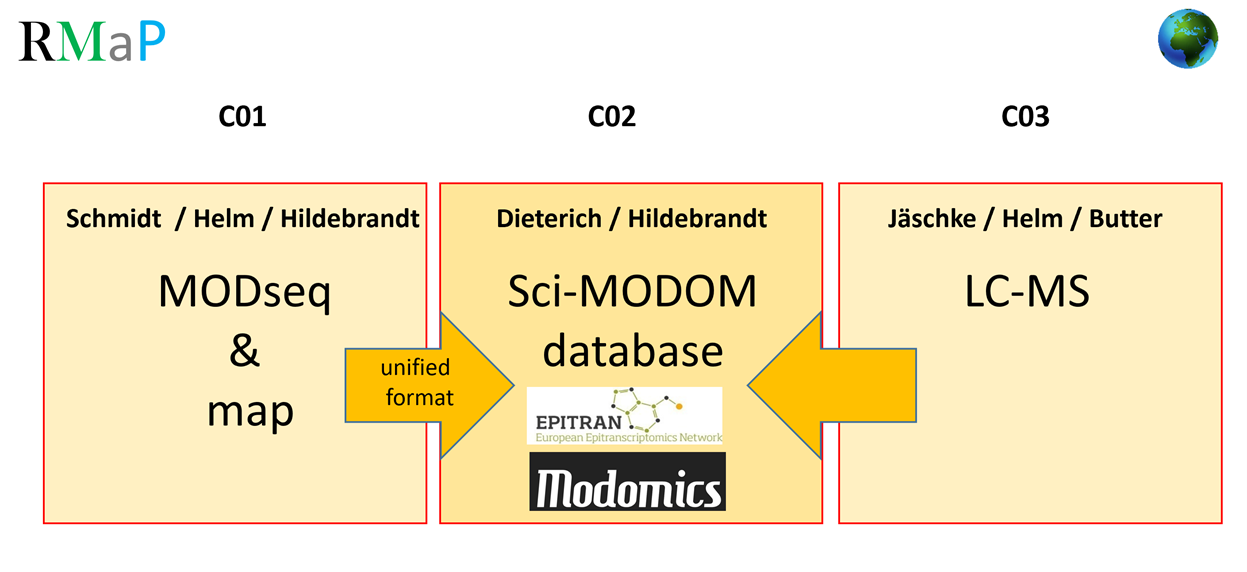
C01
Novel modification mapping techniques and their application to single cell epitranscriptomics
We will explore and develop different options to implement epitranscriptomics on the single-cell level. Both, established as well as newly developed RNA modification mapping techniques will be evaluated for their biochemical compatibility to be applied to a specific variant of single-cell RNA sequencing. Adaptations to single-cell mode will be implemented for a maximum of different modifications and RNA species, with the aim to establish an epitranscriptomic atlas for vertebrate embryogenesis, using zebrafish embryos as model.
C02
Sci-ModoM – the lighthouse database of transcriptome-wide RNA modification and processing
RNA databases have played a crucial role in RNA biology, but advancing epitranscriptomics requires reliable, FAIR, and user-friendly tools and databases. The Sci-ModoM database supports the Human RNome and other Epitranscriptome Projects by setting standards for RNA modification research and ensuring long-term data management. The project aims to establish the bedRMod format and promote sustainable, data-driven approaches to mapping RNA modifications. Sci-ModoM addresses limitations in existing RNA modification databases by integrating diverse RNA types, including mRNAs, tRNAs and rRNAs, into a unified framework. Expanding Sci-ModoM to capture RNA processing and modifications at the single-molecule level will improve data comparability and drive new discoveries in RNA biology.
C03
Mass spectrometry of RNA and proteins in modified RNPs
Covalent crosslinking of proteins to the RNA in the nucleus or the cytoplasm can inhibit transcription and translation, respectively. We have recently identified that RNA-protein crosslinks (RPCs) in the messenger RNA in the cytoplasm are resolved in a dedicated translation-coupled quality control pathway. In this project, we will establish mass spectrometry-based approaches for analysis of RPCs and associated RNA modifications. We will address which RNA modifications are present in nuclear and cytoplasmic RPCs, and define the role of identified modifications in regulating the processing of crosslinked RNA and thereby RPC resolution.
C04
Precision Nanopore sequencing of RNA modifications and processing events
Summary: Nanopore direct RNA sequencing (DRS) can detect RNA modifications on single molecules but faces challenges in precision, recall, and sequencing structured RNAs. Current protocols are limited to polyadenylated RNAs, and tailored strategies for selective sequencing are lacking. The project C04 aims to develop targeted DRS approaches and improve protocols to enhance sequencing accuracy and RNA modification detection. We will establish RNA standards, quality control measures, and realistic benchmarks to improve software performance assessment. Community engagement through RMaP Challenges and hackathons will support advancements in RNA modification detection.
